 James Joo-Jin Kim Center for Korean Studies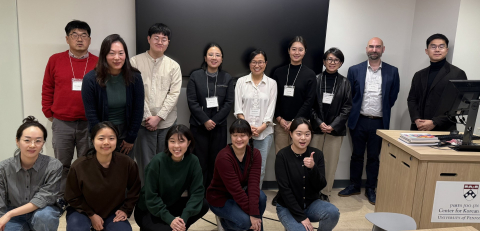
Global Korea Agenda Roundtable | November 7, 2025
Scholars of Korean Studies from institutions across the United States and Korea came together on November 7, 2025, at the University of Pennsylvania’s James Joo-Jin Kim Center for Korean Studies for the inaugural Global Korea Agenda Roundtable. Supported by the Core University Program for Korean Studies of the Ministry of Education of the Republic of Korea and Korean Studies Promotion Service at the Academy of Korean Studies (AKS-2023-OLU-2250002), the Roundtable showcased projects by scholars of various stages on Dating and Intimacy in Korea.
A key issue in South Korean society’s contemporary demographic changes is the decline in fertility. Hyunjoon Park, Director of the Kim Center and Korea Foundation Professor of Sociology at the University of Pennsylvania, highlighted the Roundtable’s aim to contribute to understanding this demographic change by “going beyond only looking at why Korean young adults do not want to have children and examining broader changes in dating and intimacy”.
The Nature of Intimacy
The Roundtable kicked off with a project by Meera Choi, a PhD Candidate in Sociology at Yale University, addressing the nature of heterosexual intimacy in Korea. Drawing on interviews with 58 heterosexual women, Choi argued that desire for heterosexual intimacy in Korea is morally and politically structured. The widening gendered ideological divide between men (who increasingly embrace anti-feminism and "fairness" rhetoric) and women (who have a heightened feminist consciousness) in the country has made heterosexual intimacy nearly impossible for many. Women are now deliberately withholding romantic participation from heterosexual relationships. This strategic withdrawal is an ethical response to the need to front-load vetting for a man's gender sensitivity and structural awareness.
Complementing Choi's focus on ideological barriers, Soo-Yeon Yoon, Associate Professor of Sociology at Sonoma State University, presented her collaborative project with Hyunjoon Park on the structural and socioeconomic stratification of dating. They find that education levels and gender predict not only the likelihood of being in a committed relationship but also interest in dating. This may be due to men and women “navigating dating differently because of cultural expectations around emotional labor, commitment, or gender norms”.
Alex J. Nelson, Assistant Professor of Anthropology at the University of Indianapolis, addressed such gendered differences in intimacy in his work. Based on ethnographic work, interviews, and surveys he conducted in Seoul, Nelson finds that men and women have different ideas about sacrifice and Agapic love: “Women see the sacrifices they are expected to make as less compatible with their sense of self, and more likely to occur, than those expected by men.” Such mismatched expectations lead to friction between men and women in romantic relationships.
The Roundtable also addressed the nature of intimacy for queer individuals. Jieha Lee, Professor of Social Welfare at Soongsil University, presented her project on queer women in Korea that she is co-authoring with Hyeyoung Woo, Professor of Sociology and Director of the Institute for Asian Studies at Portland State University. Lee emphasized that “perhaps our most important finding concerns the nature of intimacy itself”: queer women in South Korea are forced into anonymity due to social stigma and fear of being outed, which makes it difficult to forge close friendships. And perhaps as a result, queer women seek to cohabitate and tend to “desire mutual emotional support rather than a physical partnership.”
Dating and Intimacy: More Than Just a Path to Marriage
The Roundtable revealed both parallels and discontinuities between dating and marriage. Hyunjoon Park noted that it is an important moment in Korea where we wonder whether young people in Korea “are giving up, not able to forge romantic relationships,” let alone get married and have kids, in a way that is reminiscent of marriage being a luxury in Korea. Yena Lee, a Postdoctoral Fellow at the University of Pennsylvania’s Annenberg School of Communication, was “struck by how much intimacy was shaped by structural factors [because she] thought that dating would be freer from such restrictions” compared to issues of marriage and fertility.
This theme was further explored by Jeewoo Shin, a PhD Candidate at University at Albany, SUNY, in her presentation on interracial partnering attitudes among second-generation immigrant adolescents in South Korea. Her research provided a structural lens on the difference between dating as an "individual choice" and marriage as a "socially evaluated choice." Shin found that marriage trajectories show more social resistance than dating, demonstrating how assimilation and belonging are negotiated by factors like racial disclosure and visibility. This suggests that intimate choices are deeply shaped by families acting as “gatekeepers of assimilation” who reinforce boundaries around who is an acceptable partner.
Participants noted that dating and intimacy can be and should be explored as an independent phenomenon, as opposed to merely a pathway to fertility. Jeewoo Shin shared that “people are putting intimate relationships aside and it hasn’t received the attention it warrants.” Intimate relationships by themselves, independent of marriage or fertility, are valuable and important to society. Meera Choi added that in the realm of policy as well, policymakers overly focus on marriage and child-bearing. Echoing these sentiments, Soo-Yeon Yoon emphasized that “dating [involves] distinct interpersonal dynamics, social expectations, and life-course implications that differ from those associated with marriage, warranting dating to be studied as a phenomenon with its own social meaning.”
Looking Forward
The Roundtable addressed the nascent topic of dating and intimacy in Korea to push for potential future agendas and policy recommendations. Hyeyoung Woo, Professor of Sociology and Director of the Institute for Asian Studies at Portland State University and Hyunjoon Park served as dedicated discussants for each project. The discussants encouraged the presenters and audience to consider the broader implications of each author’s findings and possible policy measures to address the challenges young adults in Korea face today.
Reflecting on the Roundtable’s presentations, Jenny Jiyoung Bae, a PhD student in Sociology at Yale, wondered “how technology would function in intimacy,” suggesting a potential future agenda for research on the topic. Alex J. Nelson echoed that there is currently “a lack of understanding of the relationship between AI and intimacy… [which is potentially] important to look at.” Participants also discussed policy implications to promote intimacy and dating in Korea, particularly targeting perceptions of stability and spaces promoting connections.
Yena Lee noted that the Roundtable showed that “people want to date but are lacking a sense of stability,” implying that policy aiming to promote intimate relationships should promote ways to increase young Koreans’ sense of stability. Alex J. Nelson also pointed to the fact that we are seeing a “loss of third spaces” where people can socialize and cultivate intimate relationships, implying that policies to mitigate such loss may help Koreans to forge intimate relationships.
Jieha Lee and Hyeyoung Woo proposed specific legal solutions to mitigate queer Koreans’ struggles with homophobia, economic insecurity, and subdued personal connections. In describing one such measure, Lee explained that a “comprehensive anti-discrimination law at the national level [is] an important social structure that [could lead to normative change towards] equal rights of sexual minority individuals.” A Family Composition Rights Act through a partial amendment to the Civil Act could “eliminate discrimination by equally recognizing all forms of marriage, including same-sex marriage.”
Such potential solutions led to some concerns as well. Hyunjoon Park voiced that policymaking to address such issues is a balancing act in that “legal change is important but micromanaging private relationships is problematic.”
In final remarks at the Roundtable, Jeewoo Shin shared that she “really learned a lot from all of the presentations” and others echoed that the Roundtable presented opportunities for both qualitative and quantitative scholars to learn from each other in addressing the emerging topic of dating and intimacy in Korea.